

Managing a WordPress website becomes harder when you have many posts, pages, or custom post types to update. Editing each item one by one can waste time, especially when you need to change authors, categories, tags, comments, status, or other post details across multiple items.
That is where WordPress bulk actions help. They let you select several posts or pages and apply one action to all of them at the same time. For simple tasks, the default WordPress bulk edit feature can be useful. But when you need deeper control, better filtering, or faster bulk updates, the default options may feel limited.
In this tutorial, you’ll learn what bulk actions are in WordPress, how to use the default bulk edit options, and when it makes sense to use WPBULKiT – Bulk Edit WordPress Posts / Pages. We’ll also explain the difference between basic bulk actions and more advanced WordPress bulk editing so you can choose the right method for your workflow.
Quick Answer:
Bulk action in WordPress means applying the same operation to multiple items at once, such as posts, pages, products, orders, or coupons. The default WordPress bulk action system can handle simple tasks like moving posts to Trash, changing status, or assigning categories, but it becomes limited when you need advanced filtering or field-level editing.
For content management, a more practical workflow is to use WPBULKiT – Bulk Edit WordPress Posts and Pages. After installing the plugin, go to WordPress Dashboard > iThemeland > WPBULKiT, use the Filter Form to find the exact posts or pages you want to update, select them from the table, and apply the required bulk edit action from the plugin interface.
This approach is useful when you need to update authors, categories, tags, post status, excerpts, featured images, publish dates, or other post fields in bulk. WPBULKiT plugin extends the basic WordPress bulk action concept by giving you better filtering, table-based editing, and safer control over large-scale content updates.
How to use bulk editing post features in WordPress?
The bulk actions are available for editing below features of posts by default in WordPress:
- Categories and tags
- Author.
- Comments.
- Formats.
- Pingbacks.
- Make Sticky.
The bulk actions WordPress are available for editing below features of pages by default:
- Author.
- Parent page.
- Template.
- Comments.
- Status.
Let’s take a look at how doing bulk action in WordPress can help you to make your desired changes very fast and easy on multiple posts.
WordPress bulk edit posts
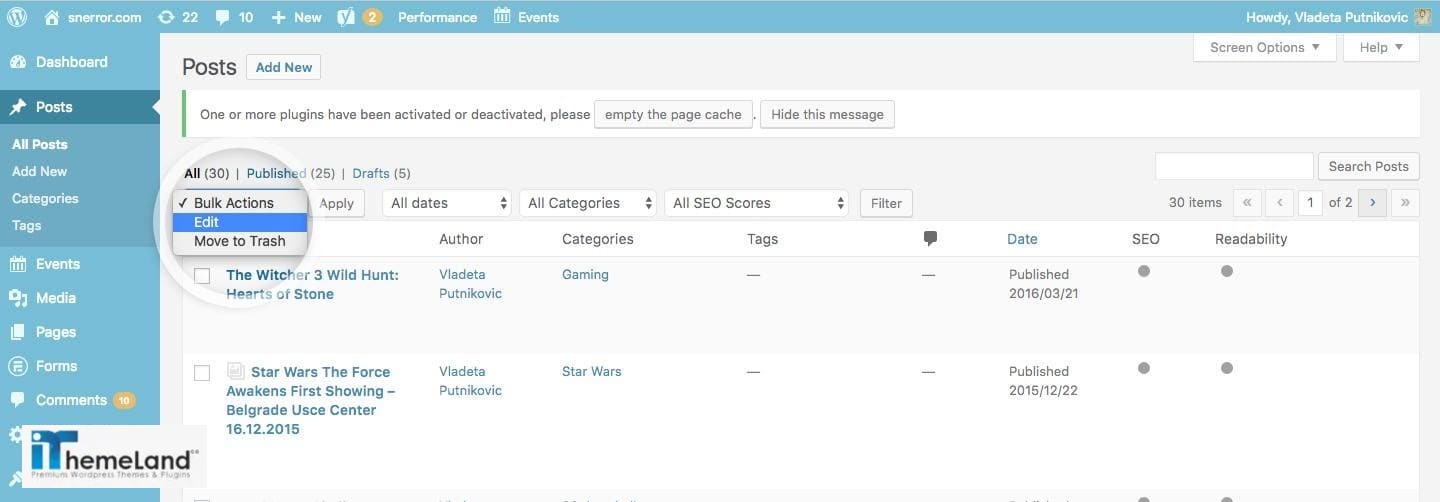
To do bulk edit actions in WordPress, at first you need to mark the posts or pages that need to be edited.
Then you have to choose edit from the bulk actions combo box above the posts or pages list:
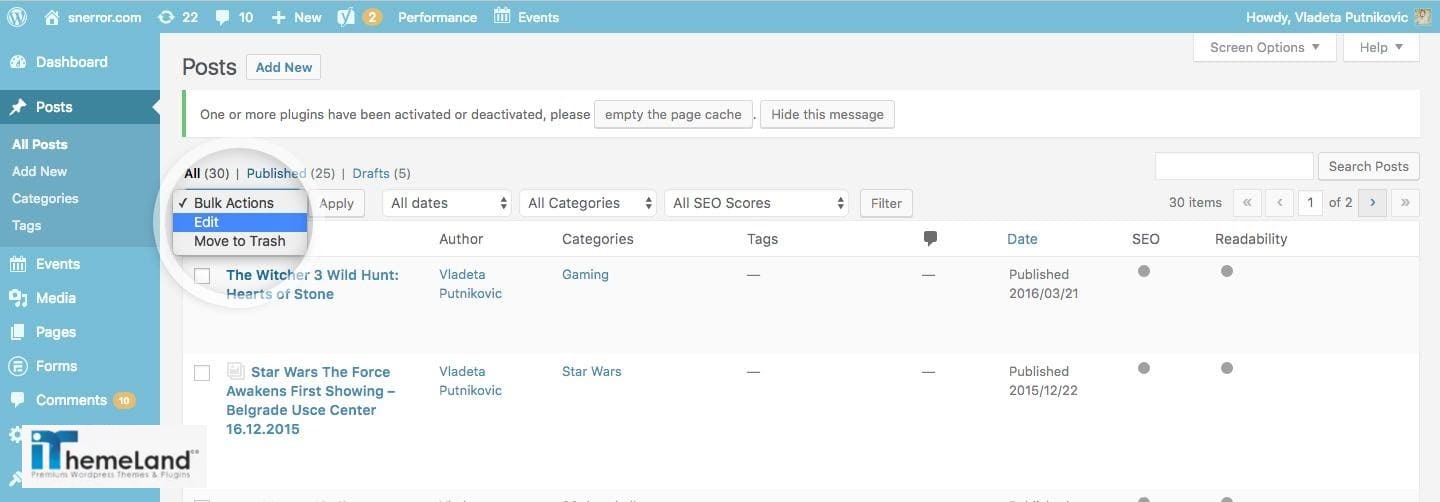
It’s then possible to make changes to the available features of those selected posts or pages at the same time.
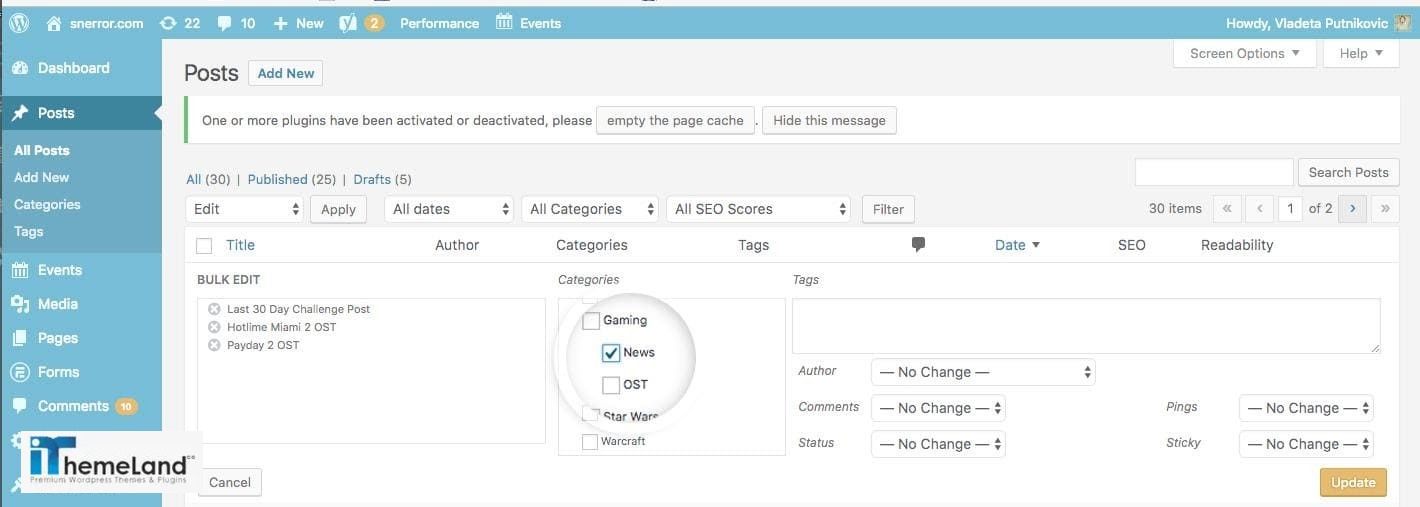
WordPress bulk edit categories
For example, if you choose a new category to be assigned to them:
Then click on “Apply“:
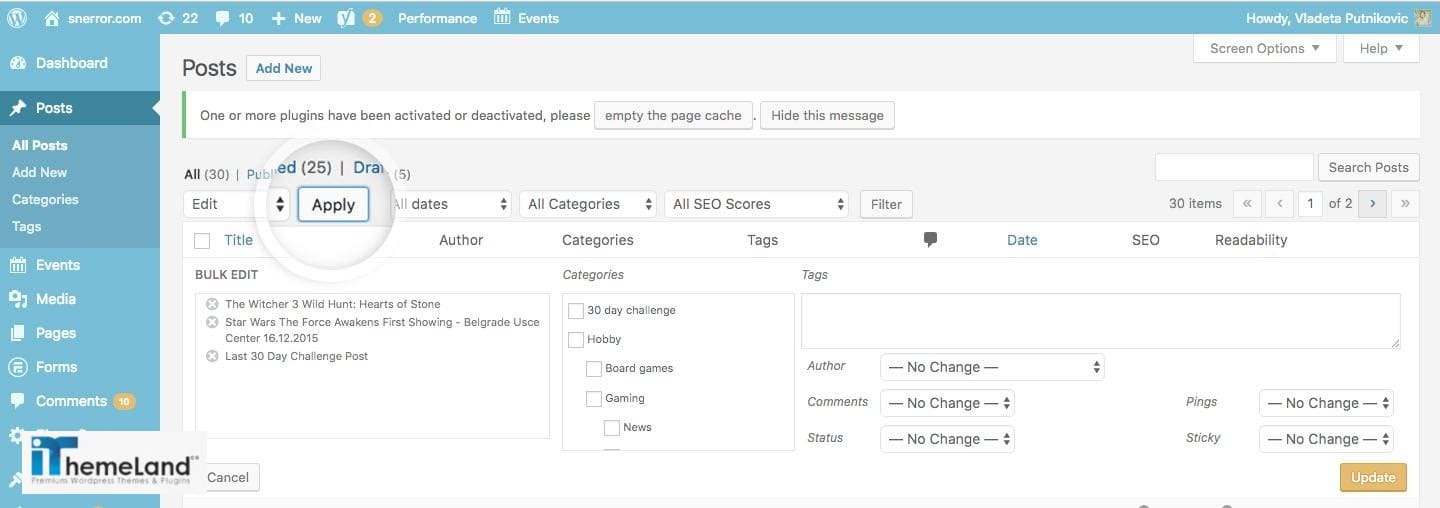
The category of those selected posts will be changed simultaneously.
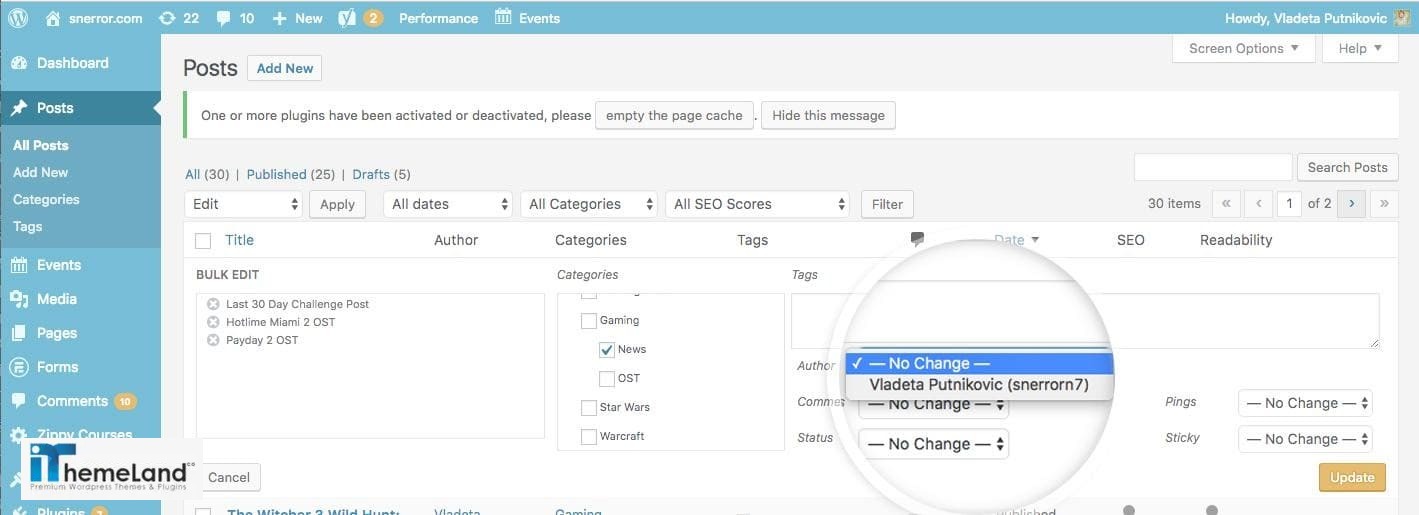
WordPress bulk edit authors
Bulk change author WordPress is also possible as below:
WordPress bulk edit tags
And you can change tags for multiple posts/pages as well:

Delete multiple post / custom post
It is also possible to bulk delete multiple posts or pages in the same way by marking preferred posts/pages then choosing move to trash option from the Bulk actions combo box.
Limitations of default bulk actions WordPress
There is no doubt that these options are very useful for handling and managing multiple posts and pages in WordPress, however, they are not as flexible as you may need for making changes on any features of your posts/ pages such as titles, images, publishing status, post contents, custom fields and so on.
To overcome these restrictions, you have to use one of the below methods:
Add bulk actions to the WordPress by code writings
Activating plugins that can help you to bulk edit WordPress features with more flexibility
Follow this tutorial to learn how to use these methods for bulk editing post and page features.
How to add bulk actions to WordPress by code writing?
To add bulk edit actions to WordPress, you need to follow three steps:
Step1: Write a code to add option in the bulk actions combo box
For example, you can add the below codes to add related items to the bulk actions dropdown list:
bulk_actions-edit-post
bulk_actions-edit-page
bulk_actions-edit-<post-type-name>
bulk_actions-edit-<custom-taxonomy>
bulk_actions-edit-comments
bulk_actions-plugins
bulk_actions-users
bulk_actions-upload
Step2: Write a code to make that added option do something
To make the added options do something after selecting from the dropdown list, you have to hook onto the filter handle_bulk_actions-<screen> in the same screen the option has been added.
Three arguments are available in this filter that you need to apply your auction onto:
- An URL that WordPress should redirect to.
- Name of the action that was chosen in the dropdown.
- An array of all element IDs that were checked for the bulk action.
Step3: Write a code to instruct WordPress show a notification after doing that action
To show admin notices, you can use the action admin_notices in your code.
To make it clear for you, let’s make some useful examples:
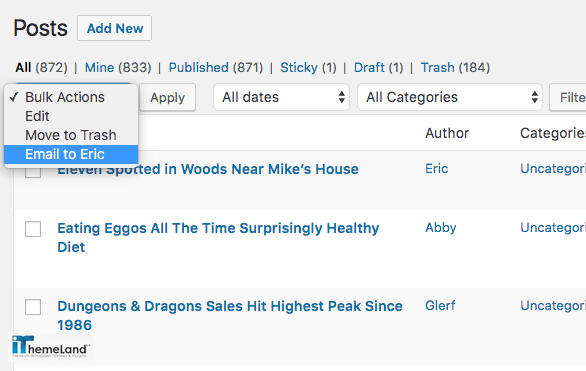
Example 1: Add Email to Eric to the bulk actions of WordPress posts
As we mentioned above you need to write a code to register a callback on the “bulk_actions-{screen_id}” filter and add this option to the dropdown list. When you are writing this code on your website, you need to replace “{screen_id}” with the ID of the admin screen.
So, you can use the below code:
add_filter( 'bulk_actions-edit-post', 'register_my_bulk_actions' ); function register_my_bulk_actions($bulk_actions) { $bulk_actions['email_to_eric'] = __( 'Email to Eric', 'email_to_eric'); return $bulk_actions;}As you can see in the below picture, the option has been added to the bulk actions combobox:
Example 2: Add “Change to publish” to the bulk actions of WordPress posts, make it do its task and show notification
To add this filter to the dropdown list (Step1), using the below code seems helpful:
add_filter('bulk_actions-edit-post', function($bulk_actions) {
$bulk_actions['change-to-published'] = __('Change to published', 'txtdomain');
return $bulk_actions;
});
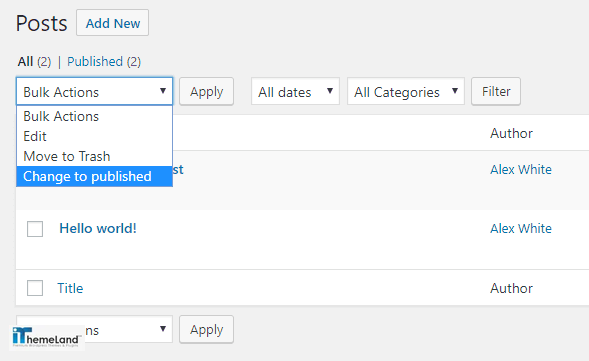
After saving and refreshing posts screen, you can see the “Change to published” has been added to the bulk actions combo box:
To make the Changed to publish loops through all post IDs and perform the bulk action (Step2), you need to add the below code in the same screen to performs “wp_update_post()” on each ID to change their post status to published:
add_filter('handle_bulk_actions-edit-post', function($redirect_url, $action, $post_ids) {
if ($action == 'change-to-published') {
foreach ($post_ids as $post_id) {
wp_update_post([
'ID' => $post_id,
'post_status' => 'publish'
]);
}
$redirect_url = add_query_arg('changed-to-published', count($post_ids), $redirect_url);
}
return $redirect_url;
}, 10, 3);
By using this code, you added a new query arg with “add_query_arg()” setting ‘changed-to-published‘ to the number of post IDs that were selected and expect to:
- Do your auction on the selected IDs.
- Build a URL to instruct WordPress to redirect to.
- Show an admin notification.
To instruct WordPress to show a notice after the bulk action is done (Step3), you can use the action admin_notices in your code as below:
add_action('admin_notices', function() {
if (!empty($_REQUEST['changed-to-published'])) {
$num_changed = (int) $_REQUEST['changed-to-published'];
printf('<div id="message" class="updated notice is-dismissable"><p>' . __('Published %d posts.', 'txtdomain') . '</p></div>', $num_changed); }
});
In this piece of code, you have checked PHP’s global variable, $_REQUEST, that are populated with form submitted values if ‘changed-to-published‘ exists. If it confirms that WordPress has completed the bulk action, it reloads the page with the following in the URL: “wp-admin/edit.php?changed-to-published=’number of published posts’”.
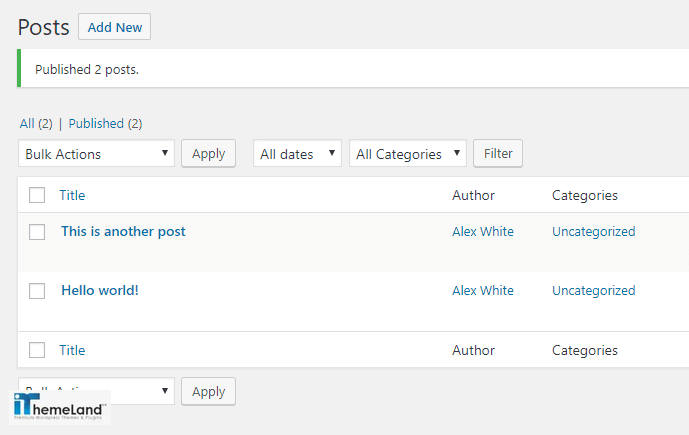
For example, if 2 posts are published after doing this bulk action, the below notice will be displayed after reloading the page:
Example 3: Update a custom post meta that informs whether or not posts are verified
To do WordPress bulk action for any selected items, you can simply use “handle_bulk_actions-<screen>” hook. So, if you want to update a custom post meta that informs whether or not posts are verified using a custom bulk action with key ‘mark-as-verified‘ as below is helpful:
add_filter('handle_bulk_actions-edit-post', function($redirect_url, $action, $post_ids) {
if ($action == 'mark-as-verified') {
foreach ($post_ids as $post_id) {
update_post_meta($post_id, 'verified', '1');}
$redirect_url = add_query_arg('mark-as-verified', count($post_ids), $redirect_url);}
return $redirect_url;
}, 10, 3);
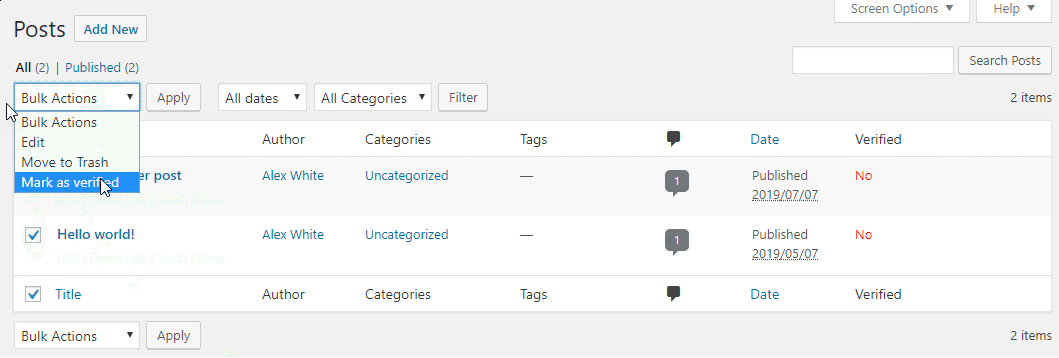
By using this piece of code, a custom column is also added that shows the value of ‘verified’ in posts lists as you can see in the below picture:
What is WordPress post bulk edit plugin?
If you are not good at using codes or adding them to your WordPress website for customizing bulk actions, there is nothing to worry about. About 70% of web owners who powered their site with WordPress have are in the same situation and have zero knowledge about code writing. The best solution for doing bulk action without even wring a single line of code is using WordPress bulk actions plugins.
There are a lot of free or premium bulk edit plugins available in the WordPress respiratory or third-party websites to help you edit and customize multiple posts or pages features at the same time.
The free WordPress post/page bulk edit plugin usually offers some limited options for editing the features. They contain a piece of code like the examples we mentioned above to help you do one or two bulk editing actions on your posts or pages.
While the premium bulk editing plugins provide a lot more flexible and comprehensive options for editing and customizing features of multi posts or pages. By activation of them on your WordPress site, you may have access to a spreadsheet or a table including all of your posts or pages which really facilitate filtering and editing any features by working with their user-friendly interface.
Stay with us to see how you can use these powerful plugins for doing bulk edit actions on WordPress.
- Switch WordPress post types
It is very common for sit managers to need to change the types of multiple posts at the same time. By default, there are five types in WordPress that you can assign to your posts including:
- Posts.
- Pages.
- Attachments.
- Revisions.
- Menus.
Consider that you want to change the types of 20 posts in one day, it’s obvious that this task is very frustrating and time-consuming if you have to open their pages individually and change their types one by one.
However, there are some free plugins such as Post Type Switcher plugin available in the WordPress respiratory that you can easily install and activate them to do bulk action for changing post types.
To switch multiple post types by bulk editing after activation of the Post Type Switcher plugin on your WordPress website, follow the below actions:
- Go to “All Posts”.
- Mark the posts you want to switch their types.
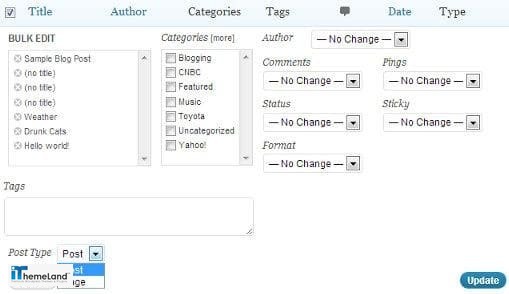
- In the Bulk Actions drop-down list, select Edit and press the Apply button to see all selected posts in Quick edit mode.
- Switch the “post type” as you prefer.
- Filter, select and change specific posts
To filter, select and change specific posts, you need to install a free or premium plugin on your site as these features are not available by default on WordPress websites. One of the most helpful plugins for doing these tasks is Search & Filter plugin.
When this plugin is activated on your website, a new menu item appears on the WordPress admin bar labeled Search & Filter. If you click on this tab, you will see some useful information about how to use the shortcodes to add Filtering and searching options to your posts or pages.
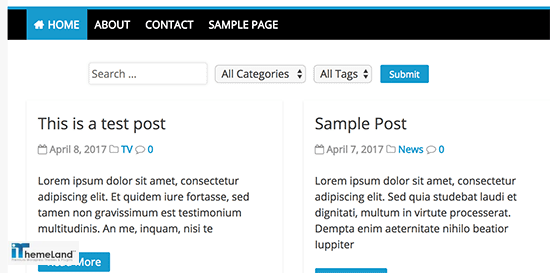
For example, you can use the below shortcode in any post or page to build a search box with search, category, and tags fields:
[searchandfilter fields="search,category,post_tag"]The result looks like below:
- Adding or editing post in a short time
Adding or editing posts in a short time needs a powerful plugin to be installed on WordPress websites to make these options available for doing bulk actions on the selected posts. There are more than 100 plugins that can help you to add or edit multiposts at the same time.
For example, “WPBE – WordPress Posts Bulk Editor Professional” is one of the most popular plugins designed to help you manage and edit the data of multiple posts, pages, or custom posts in a short time.
By activation of this bulk post-editing plugin, you are can filter your preferred posts then do bulk edit actions to edit their fields or meta fields at the same time.
WPBE provides all necessary options for facilitating bulk actions such as bind editing. The only disadvantage that may disappoint you to install this plugin is its compatibility. Unfortunately, WordPress Posts Bulk Editor Professional is not compatible with WooCommerce so if you have already installed WooCommerce on your website it’s better not to use WPBE for bulk editing.
- Duplicate posts / custom posts
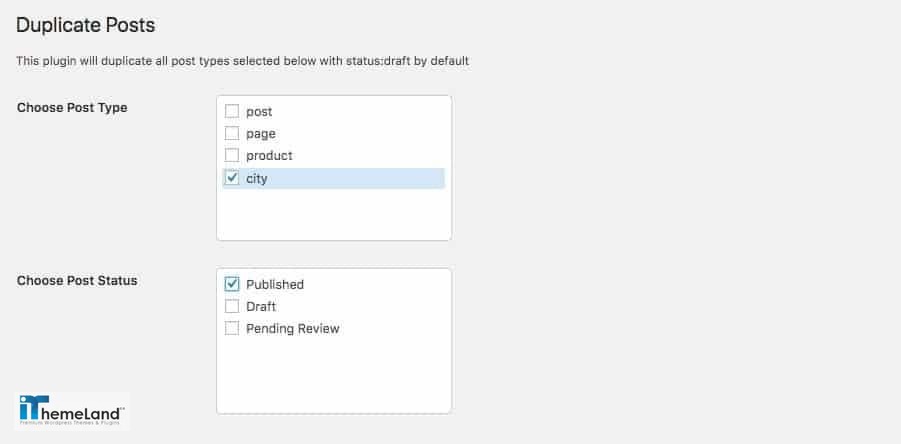
Duplicating multiple posts/custom posts is another feature that you may need for managing your website which is not provided on WordPress by default. To perform this action, you need to use some WordPress plugins like WP Bulk Post Duplicator.
If you want to duplicate multiple posts by this plugin, you just need to specify their post type, status, and date of publishing:
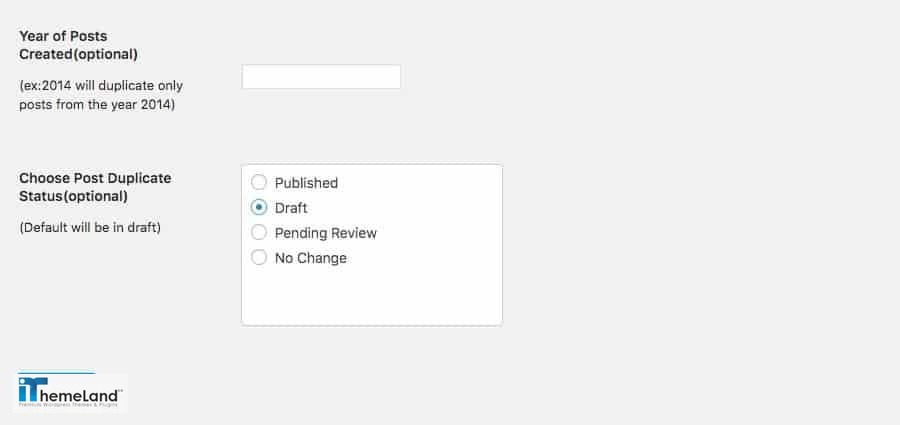
You can also specify the status of duplicated posts, then by clicking on the Duplicate button, all of them will be duplicated in a few seconds.
- Bind editing
Bind editing is an effective and flexible way for doing bulk actions on the post or page data. WordPress Bulk Posts Editing Plugin is one of the most powerful plugins that enable you to do both bulk editing and bind editing of multiple post fields or meta fields.
In this plugin, all of your posts will be displayed in a table and you can add the post data as the columns to the table.
It is also possible to filter posts according to any field such as status, publish date, etc. Then bulk edit the data you need by using a comprehensive bulk edit form containing all data related to the posts or bind editing any column directly on the table columns.
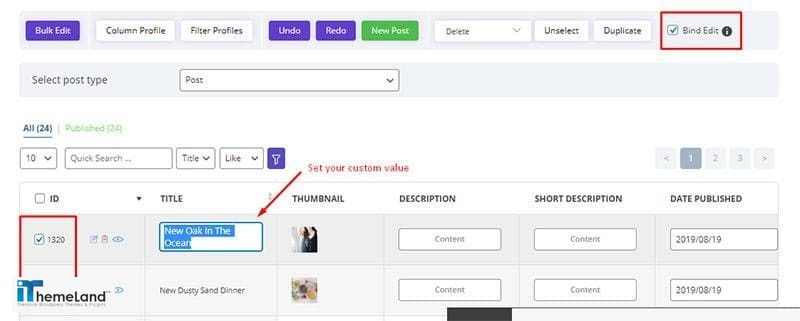
To bind edit post data on the table of WordPress bulk posts editing plugin, you just need to:
- Mark the “Bind Edit” option in “Toolbar”
- Check your preferred posts or custom posts in the table
- Edit the desired fields with the desired values, it is enough to do this only for one of the posts
This plugin has a very user-friendly interface and it is compatible with most of the common plugins of WordPress such as WooCommerce.
Conclusion
WordPress bulk actions are a simple but powerful way to manage multiple posts or pages without opening each item separately. They are useful for quick updates like changing categories, assigning authors, editing status, allowing comments, or moving several posts to trash.
However, the default bulk action system is limited. It works well for basic edits, but it does not give you full control over post titles, content, custom fields, featured images, metadata, advanced filtering, or large-scale content updates. For content-heavy websites, this can slow down your editorial and site management process.
If you need a faster and more flexible way to bulk edit WordPress posts and pages, WPBULKiT – Bulk Edit WordPress Posts / Pages gives you a practical solution. You can filter content, select the exact posts you want, edit fields in bulk, and manage updates from a table-style interface instead of repeating the same task manually.
FAQ
1. What are WordPress bulk actions?
WordPress bulk actions are tools that let you select multiple posts, pages, comments, users, or other items and apply one action to all of them at the same time. For example, you can move several posts to trash, change their status, or edit basic post settings together.
2. How do I use bulk actions in WordPress?
Go to the post or page list in your WordPress dashboard, select the items you want to update, choose an option from the Bulk actions dropdown, and click Apply. WordPress will then apply that action to all selected items.
3. What can I bulk edit in WordPress by default?
By default, WordPress lets you bulk edit some basic fields such as categories, tags, author, comments, status, and format for posts. For pages, you can usually edit fields like author, parent page, template, comments, and status.
4. What is the difference between bulk actions and bulk edit in WordPress?
Bulk actions are the general actions you can apply to multiple selected items, such as Edit or Move to Trash. Bulk edit is one specific bulk action that lets you update editable fields for several posts or pages at once.
5. Can I bulk update posts in WordPress?
Yes. You can bulk update posts using the default WordPress bulk edit feature. For more advanced updates, such as editing many post fields, filtering specific posts, or managing custom post data, WPBULKiT – Bulk Edit WordPress Posts / Pages gives you more flexibility.
6. Are WordPress bulk actions enough for large websites?
For small websites, default bulk actions may be enough. But for large blogs, content teams, directories, or websites with many custom post types, the default options are usually limited because they do not support many advanced fields or filtering options.
7. Can I create custom bulk actions in WordPress?
Yes. Developers can create custom bulk actions with WordPress hooks and custom code. This is useful when you want to add a specific action to the WordPress admin list, but it requires technical knowledge.
8. When should I use a WordPress bulk edit plugin?
You should use a WordPress bulk edit plugin when you need to update many posts or pages faster, filter items more accurately, edit advanced fields, or avoid repetitive manual work. This is especially useful for websites with large content libraries.